01 · Guide
3D printing for medical training: what it can and cannot teach.
3D printing builds a medical training model layer by layer from a digital design, so a training team or device company can have anatomy or a device shape that no catalogue stocks. A rigid printed model is good for routes, anatomy and handling. It does not behave like tissue. Clean Layers makes these models in our UK workshops.
02 · What is a printed model used for in medical training?
What is a printed model used for in medical training?
3D printing is used for anatomy a team can name and travel, for procedural task trainers and for a solid model of a device a company sells. A narrative review of the method in anatomy education and surgical training describes these uses beside dissection and atlases (Li, Kui et al., MedEdPublish, 2017). The same review states two limits. Very small structures still cannot be replicated, and a printed model does not give the tissue feel of a cadaveric specimen.
This guide is for simulation and training leads, clinical educators and training teams at device companies.
Solid models matched to the device you sell, from your geometry, and our own training models for bronchoscopy and ureteroscopy. You send the geometry. We make a solid model so your team can show how the device works. Each piece is checked before it leaves. They are listed under medical training and demonstration models. These are demonstration models. They are not for clinical use. They are not medical devices.
03 · What can a rigid printed model teach, and what can it not?
What can a rigid printed model teach, and what can it not?
A rigid printed model can teach routes, names and scope handling, and it cannot show tissue, a lesion or a wall that gives way under the scope. The worked examples are the bronchoscopy training airway and the ureteroscopy training kidney.
| Teaches well | Does not show | |
|---|---|---|
| Airway routes | 5 lobes, 18 segmental bronchi, 36 open tips. | The airways end at the subsegmental level, so it does not reach the peripheral lung where many nodules lie. |
| Airway handling | Combine tip flexion, rotation, advance and withdrawal to enter a chosen lobar or segmental opening. | The cartilage rings are on the outside, so the inside of the trachea looks smooth through a scope. |
| Names | 23 labels are engraved into the surface: 5 lobes and 18 segments. | There is no tissue, lesion or mucosa. The stations are markers, with no ultrasound image behind them. |
| Scope choice | Choose the scope size that will reach a given segment. A 4.0 mm scope reaches every opening. | The model is adult-sized, so it cannot teach the tight fit of a small airway. |
| Kidney stones | Basket a stone and pull it out through the sheath. | Printed stones do not break up, so they suit basketing, not laser work. |
| Kidney walls | Pass from the access sheath through the ureteropelvic junction into the renal pelvis. | The walls are rigid and dry. A real collecting system distends under irrigation and gives way to the scope. |
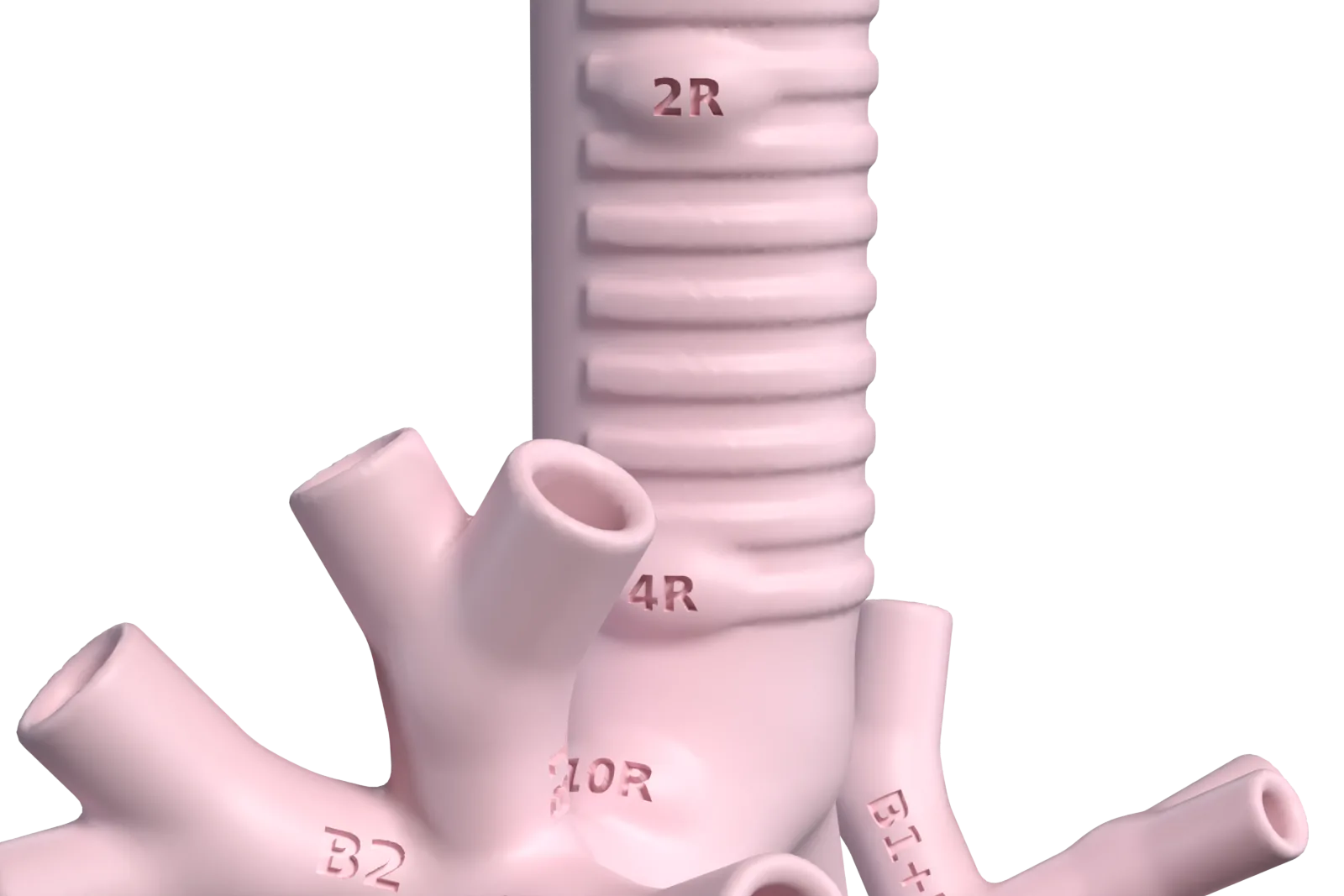
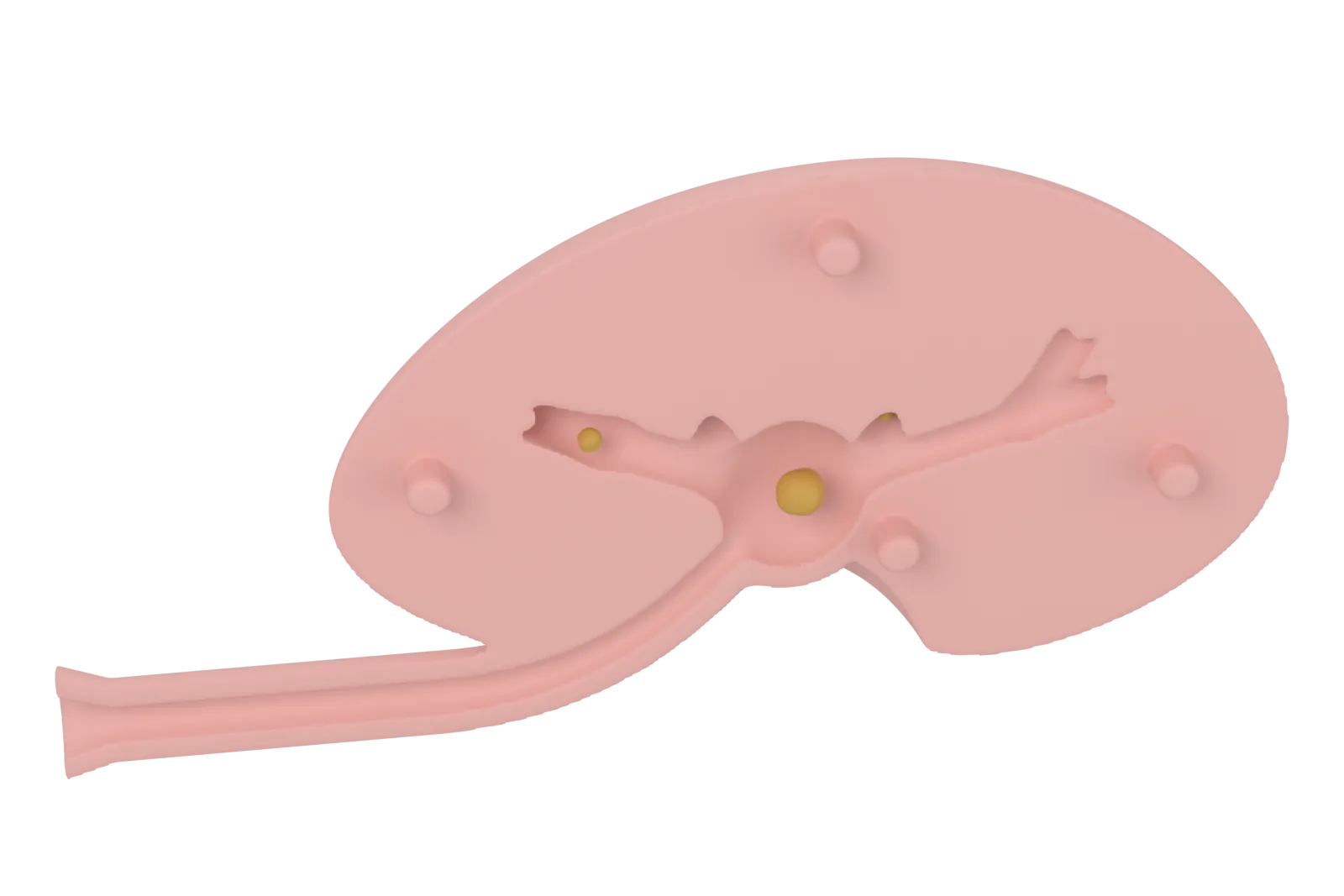
On the airway, children have the same lobes and segments, so the routes and names carry over. On the kidney, use it dry. It is not sealed, so do not run irrigation through it. There is no mucosa, bleeding or renal vessels, and each cartridge is one anatomy.
A training and demonstration model, not a medical device, and not a clinical validation.
04 · How accurate is a 3D printed anatomy model?
How accurate is a 3D printed anatomy model?
A printed anatomy model is only as accurate as its source data and the design record behind it. Ask the supplier where each value comes from.
The bronchoscopy training airway is a life-size adult airway a scope can travel, built to the average adult male airway in a published CT study. Every design value is written down with its source. This compares the design with published averages. It is not a clinical validation. The model shows one normal anatomy, without variants such as a tracheal bronchus. Women's central airways are on average 13–21% narrower.
The ureteroscopy training kidney is a life-size adult right kidney. The outer form is fitted to CT scans of 33 adult right kidneys. This compares the design with published averages. It is not a clinical validation. Each cartridge shows one normal anatomy, and real kidneys vary widely. The renal vessels are not modelled.
On the airway, an airway counts when it is at least as wide as the scope, so a 4.0 mm scope has no clearance in the narrowest ones. This compares published scope diameters with the design. Bends and friction reduce reach, and no scope has been through a finished model yet, so check tight fits with your own scope.
On the kidney, reach is modelled for an 8.6 Fr flexible ureteroscope at its measured bend, in one plane, through rigid walls: a best case. A real collecting system distends under irrigation and gives way to the scope, so the print is harder than a patient. No scope has been through a printed model yet, so check tight fits with your own scope.
Dimensions, wall thickness and the size of each branch are shared on enquiry. Ask where each value comes from, and whether a scope has been through a finished model.
05 · Should you print training models in-house or commission them?
Should you print training models in-house or commission them?
Print in-house when you have the time, the skills and a simple design. Commission the work when you need a documented design, repeat units made the same way or a model of a device you sell. Clean Layers uses the same five steps for one prototype and for a production run. Every piece is made in our UK workshops.
- Brief. What the piece has to do, where it will be used and what it has to prove.
- Model. We work from your geometry or model it with you. For our own models, every design value is written down with its source.
- Make. Thicker walls and a denser internal structure wherever the design allows. Strength over speed.
- Check. Each piece is checked before it leaves.
- Deliver. With the documents you asked for, and how to look after it.
Lead time, file format and run size are part of the brief. Tell us the device, the geometry, how many you need and when. We work to that brief. We reply by email.
06 · What are 3D printed training models made from?
What are 3D printed training models made from?
The bronchoscopy training airway is PLA, a plant-derived polymer, and the ureteroscopy training kidney is PETG, matte light pink. Both of these models are rigid. Stones in amber. PLA starts to soften at about 55°C. PETG takes a little more, but not a dishwasher. Once a piece slumps, it does not go back.
For a model of your device, the material is part of the brief. We work to that brief.
07 · Can you clean or sterilise a 3D printed training model?
Can you clean or sterilise a 3D printed training model?
Wipe the airway and the kidney clean, and do not sterilise or autoclave them. Steam and an autoclave run well past 55°C, which is where PLA starts to soften. The two models are not cleaned the same way.
The airway is PLA. Wipe inside and out with mild soap and lukewarm water, rinse, and let it dry fully. No bleach or solvents. PLA starts to soften at about 55°C. Do not sterilise or autoclave it, or put it in a dishwasher. Use only clean scopes and instruments that have not been used on patients.
The kidney is PETG. Wipe it with 70% isopropyl alcohol and let it dry. Do not soak it, and try any other disinfectant wipe on a hidden spot first. Do not leave it on a car dashboard in the sun. Do not sterilise or autoclave it, or put it in a dishwasher. Use only clean scopes, sheaths and baskets that have not been used on patients.
Those lines are care instructions, not a claim that a wipe disinfects the piece. These are demonstration models. They are not for clinical use. They are not medical devices. Heat, sun and washing for a PLA piece are set out in how to look after a PLA piece.
08 · What should you put in a brief for a training or demonstration model?
What should you put in a brief for a training or demonstration model?
Tell us the device, the geometry, how many you need and when. Add the scopes or instruments the model must take. We work from your geometry or model it with you. We reply by email.
- The device or the anatomy the model has to show.
- The source geometry, in the form you already have. The format is agreed in the brief.
- The instruments, scopes and sizes the model must accept.
- What the model has to show, and what it should not be asked to show.
- How many you need. The same five steps cover one prototype and a production run.
- The date you need them. The lead time is agreed in the brief.
- The documents you need. All material lab test documentation comes with the models.
- Confidentiality. Clean Layers signs NDAs.
Where a point above is still open, say so. We work to the brief you send. Clean Layers signs NDAs, and all material lab test documentation comes with the models.
09 · Questions
Questions
-
Is a printed training model a medical device?
No. These are demonstration models. They are not for clinical use. They are not medical devices. A training and demonstration model, not a medical device, and not a clinical validation.
-
Can you autoclave a PLA training model?
No. PLA starts to soften at about 55°C. Do not sterilise or autoclave it, or put it in a dishwasher.
-
Can a printed model replace practice on tissue?
No. There is no tissue, lesion or mucosa. The walls are rigid and dry. A real collecting system distends under irrigation and gives way to the scope. Printed stones do not break up, so they suit basketing, not laser work.
-
Can you make a model of our device?
You send the geometry. We make a solid model so your team can show how the device works. Each piece is checked before it leaves. These are demonstration models. They are not for clinical use. They are not medical devices.
-
Can you make one model or a full run?
The same five steps for one prototype and for a production run. Tell us how many you need and when.
-
Do you sign a confidentiality agreement?
Yes. Clean Layers signs NDAs.
-
What documents come with a model?
All material lab test documentation comes with the models. The piece also leaves with the documents you asked for, and how to look after it.